
Levo guides · System Data
System Data on a developer’s Mac: what fills it and what can go
On a developer’s Mac, System Data is mostly your toolchain: iOS simulators, Docker’s disk image, package caches, build output and, now, coding agents’ worktrees. Almost all of it can be rebuilt or downloaded again, which makes it the safest big thing to clear.
| What | Where | Size it | Safe? |
|---|---|---|---|
| Simulators and runtimes | ~/Library/Developer/CoreSimulator | du -sh that folder | Yes, runtimes re-download |
| Xcode build data | ~/Library/Developer/Xcode/DerivedData | du -sh | Yes, rebuilt |
| Device support | ~/Library/Developer/Xcode/iOS DeviceSupport | du -sh | Yes, recreated on connect |
| Docker | ~/Library/Containers/com.docker.docker | docker system df | Images yes, volumes no |
| Package caches | ~/.npm, ~/.gradle/caches, ~/.cargo, ~/Library/Caches/Homebrew | du -sh | Yes, downloaded again |
| Build output | node_modules, build, target in old projects | Find below | Yes, if the project is idle |
| Agent worktrees | Git worktrees made by coding agents | git worktree list | Only if merged and clean |
How to do it yourself
Size first, then delete from the biggest down. This one command lists the biggest of the usual suspects:
du -sh ~/Library/Developer/* ~/Library/Developer/Xcode/* ~/.npm ~/.gradle ~/.cargo ~/Library/Caches/Homebrew 2>/dev/null | sort -hSimulators. Remove the ones whose runtime is gone, then the ones you don’t use:
xcrun simctl delete unavailable
xcrun simctl list devices
xcrun simctl delete <device-id>
Old runtimes are in Xcode › Settings › Components. Delete them there, not from the folder by hand.
Docker. See what it holds, then remove what’s stopped or unused:
docker system df
docker system prune -a
prune -a removes every image not used by a container, which means a slow pull next time. Leave out --volumes unless you’re sure: volumes hold databases.
Package caches. Each tool has its own command:
npm cache clean --force
brew cleanup -s
rm -rf ~/.gradle/caches/build-cache-*
Build output. Find the node_modules folders by size. Delete the ones in projects you haven’t opened in months:
find ~/Developer -name node_modules -type d -prune -exec du -sh {} + 2>/dev/null | sort -h | tail -20Agent worktrees. Coding agents often create a git worktree per task and leave it behind. List them from a repo:
git worktree list
git worktree remove <path>
git worktree prune
Check git status and that the branch is merged first. A worktree with uncommitted work is the one thing here you can’t get back.
How Levo does it
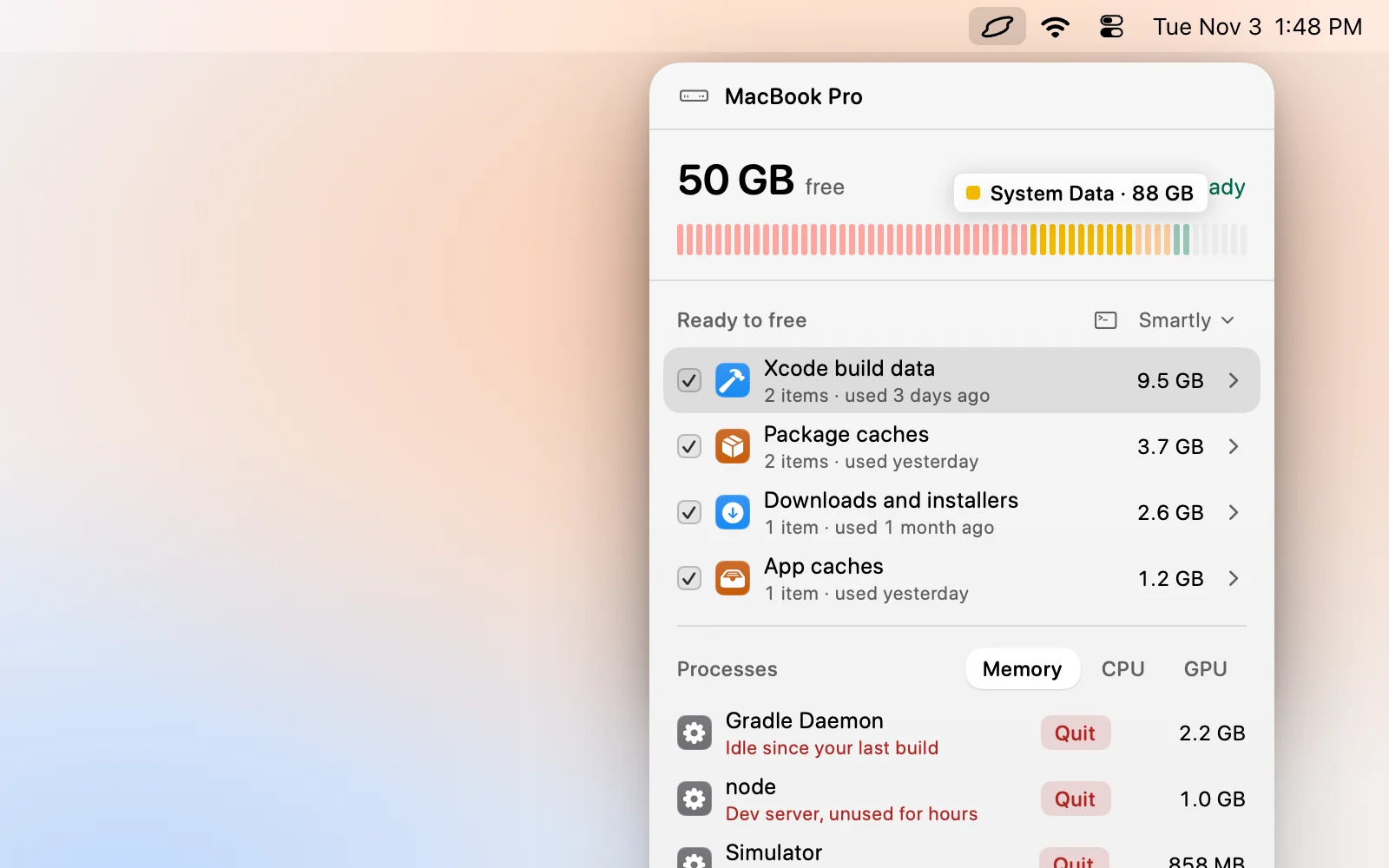
Levo is built for this kind of Mac. Its live index finds the developer data wherever it sits, and the Ready to free list groups it by kind: Xcode build data, Simulators and emulators, Package caches, Virtual machines and containers, App caches and Agent worktrees, each with a size and a reason. Your own AI agent, such as Claude Code or Codex, judges what’s safe, and Levo does the deleting itself.
It will never clean a worktree whose git work isn’t clean and merged, a live agent session, or anything open or changed in the last few minutes. Select › Smartly ticks only what’s safe at your cleanup level; virtual machines, AI models and large files are listed but never ticked for you. Levo leaves Time Machine snapshots, swap and macOS’s own files to macOS.
The details for Xcode and mobile work are in For iOS and Mac developers.
FAQ
Is it safe to delete the whole CoreSimulator folder?
Not by hand. Delete simulators with xcrun simctl and runtimes from Xcode’s settings, which keeps Xcode’s records in step. Removing the folder directly can leave Xcode confused until you reset it.
Will clearing DerivedData break my project?
No. Xcode rebuilds it on the next build, so the first build after clearing is slower.
Does docker system prune delete my databases?
Not unless you add --volumes. Without it, prune removes stopped containers, unused networks and images, and leaves volumes alone.
How do I know if an agent’s worktree can go?
Check that the branch is merged and git status is clean. If either isn’t true, the worktree holds work that exists nowhere else.